
There was a time when a “serious” skincare routine meant cleanser, toner, serum, moisturizer, SPF — and maybe a retinol if you felt emotionally ready.
But Korean skincare has always had a gift for moving the conversation forward. First came essences, sleeping masks, cushion compacts, snail mucin, and glass skin.
Now, the new frontier is more regenerative, more clinical, and honestly, much more fascinating: PDRN, exosomes, and growth factors!
These are not your basic “hydrating serum with a pretty texture” ingredients.
They belong to the new generation of skincare actives inspired by dermatology, aesthetic treatments, and skin-repair science. The promise is not just glow, but skin that looks more resilient, smoother, plumper, and better able to recover from stress.
Of course, the beauty world loves a buzzword. And when an ingredient starts appearing everywhere — especially on TikTok — it becomes hard to know what is genuinely innovative and what is just good marketing wearing a lab coat.
So let’s decode it properly: what PDRN, exosomes, and growth factors actually are, what they can do for the skin!
Korean skincare has always been ahead when it comes to texture, layering, barrier repair, and glow. But what makes the current K-beauty wave so interesting is the shift from surface radiance to skin recovery.
Instead of simply exfoliating more, mattifying more, or forcing the skin into perfection, these formulas focus on communication, regeneration, and repair. Think of it as skincare that tries to coach your skin rather than punish it.
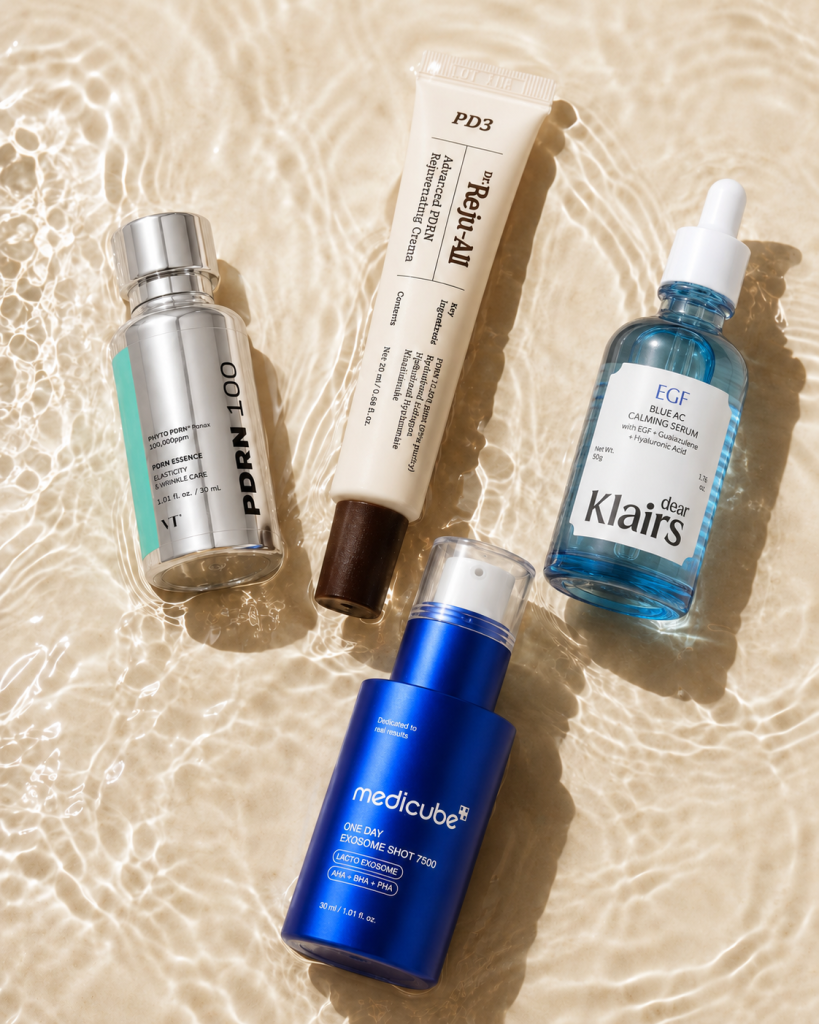
That is why these ingredients are now showing up in ampoules, serums, creams, sheet masks, and post-treatment routines, especially from Korean brands such as Rejuran, Anua, Medicube, VT Cosmetics, Easydew, and ExoCoBio/ASCE+.
PDRN stands for polydeoxyribonucleotide. In simple terms, it is a DNA-derived ingredient traditionally associated with tissue repair and skin regeneration. In Korea, PDRN became especially famous through professional “skin booster” treatments, often linked to salmon DNA-derived formulations.
In cosmetic skincare, PDRN is usually positioned as a repairing, soothing, and rejuvenating ingredient. Research on PDRN suggests it has tissue-repairing and anti-inflammatory properties, and it is studied for roles in wound healing, collagen synthesis, and skin revitalization.
PDRN is interesting because it is not just about making skin look shiny for five minutes. Its appeal is more about skin quality.
The main benefits usually associated with PDRN skincare are:
However, and this matters, topical PDRN is not the same as an injectable treatment. Injectables work deeper in the skin; topical products sit within cosmetic limits. That does not make them useless — far from it — but it means expectations should be realistic. Think improved hydration, glow, and comfort rather than “new face by Friday.”
Rejuran is probably one of the most important representations to know if you are researching PDRN. The brand is closely associated with c-PDRN skincare and positions its formulas around repair, strengthening, and rejuvenation.
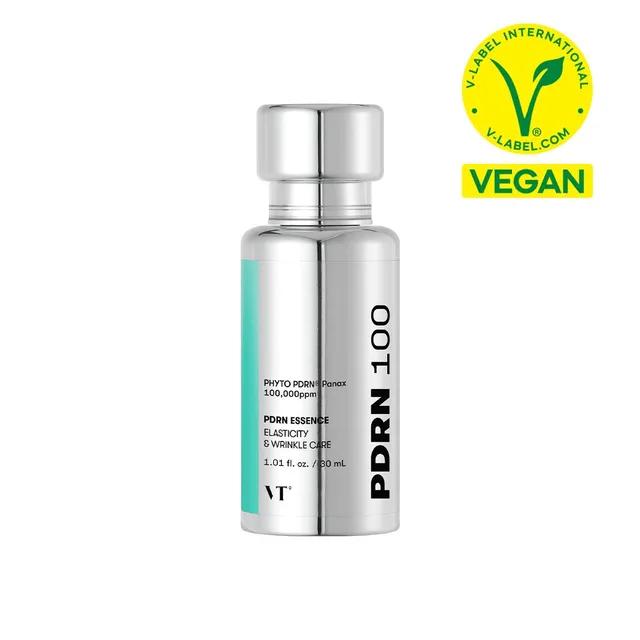
My favorite: I’ve tried VT PDRN Essence 100, with PHYTO PDRN sourced from Korean ginseng
If PDRN is about repair, exosomes are about communication.
Exosomes are tiny vesicles released by cells. Their job is to carry messages — proteins, lipids, genetic material and other signaling molecules — from one cell to another. In dermatology and aesthetics, exosomes are being studied for wound healing, scar remodeling, rejuvenation, and hair-related applications.
In beauty language, exosomes are often described as microscopic messengers that help encourage skin to behave in a healthier, more youthful-looking way.
Exosome skincare is usually marketed for:
But this is where we need to be smart. Exosome skincare is exciting, yes, but also less standardized than classic ingredients like niacinamide, retinoids, or vitamin C. Dermatology reviews note that exosomes show promise, but safety, efficacy, treatment protocols, and purification standards still need more research and regulation.
That does not mean “avoid everything.” It means choose brands carefully, avoid suspicious miracle claims, and be extra cautious with exosome treatments after microneedling or lasers unless you are working with a qualified professional.
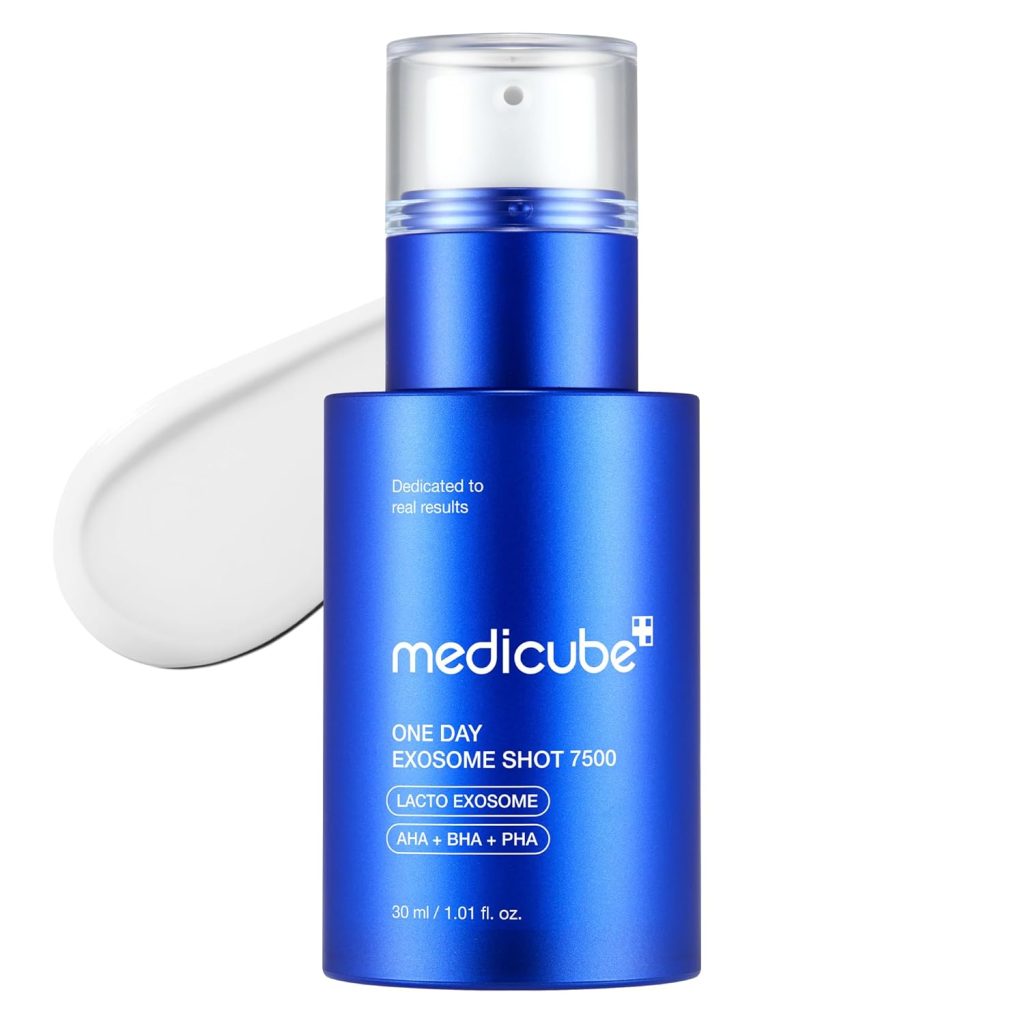
Medicube is one of the K-beauty brands most visible in the exosome conversation, especially with its One Day Exosome Shot-type products. Vogue has also highlighted Medicube’s exosome products as part of the broader regenerative skincare trend.
This is the category where I would be the most selective. Exosomes are not a cute “add to cart because the packaging is pink” ingredient. Look for transparent sourcing, credible brand history, and avoid anything that sounds too underground, too vague, or too medically dramatic.
Growth factors are naturally occurring proteins that act like skin messengers. They help support processes linked to repair, cell renewal, collagen production, and tissue maintenance. Epidermal Growth Factor, or EGF, is one of the best-known examples and has been studied for wound healing and maintaining tissue homeostasis.
In skincare, growth factors are used to help skin look smoother, firmer, and more refined. DermNet notes that daily use of skincare products containing growth factors is known to help reduce the appearance of fine lines and wrinkles and improve tone and texture.
Growth factors are especially interesting for skin that looks:
They are not exfoliants. They do not “resurface” skin like acids. They do not work like retinoids. Instead, they are more about supporting the skin’s natural repair language.
This makes them appealing for sensitive or mature skin, or for anyone who wants a more sophisticated anti-aging approach without constantly increasing irritation.
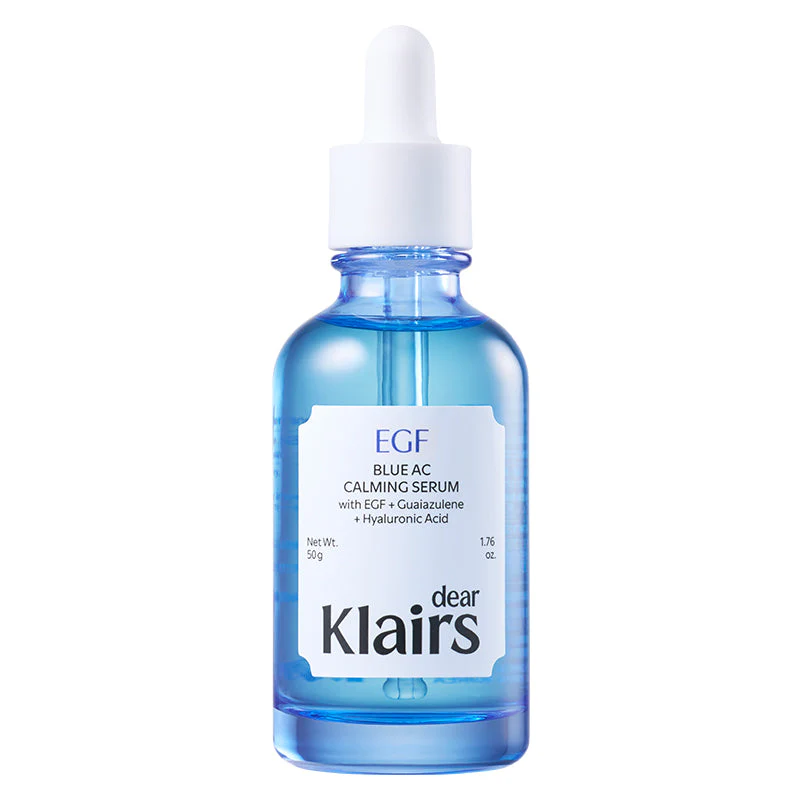
Dear Klairs EGF Blue AC Calming Serum is a gentle K-beauty growth factor serum featuring EGF/sh-Oligopeptide-1, designed to support skin repair while calming irritation.
It is especially interesting for sensitive, blemish-prone, or stressed skin thanks to soothing ingredients like guaiazulene, panthenol, and centella asiatica.
Here is the easiest way to understand them.
PDRN is best thought of as a repair-supporting ingredient. It is linked to regeneration, hydration, barrier comfort and smoother-looking skin.
Exosomes are cellular messengers. They carry signals that may help skin recovery and rejuvenation, but the category still needs stronger standardization and evidence, especially in over-the-counter skincare.
Growth factors are signaling proteins. They help support collagen, repair, and skin renewal, making them especially interesting for fine lines, texture, and firmness.
They are cousins in the same modern skincare family, but they are not interchangeable. The smartest routine does not necessarily use all three at once. It uses the right one for what your skin actually needs.
The best way to use advanced skincare is not to throw everything at your face and hope for glass skin. That is not a routine; that is a hostage situation for your barrier.
Start with one product at a time.
In the morning, you can use a hydrating PDRN serum or growth factor serum under moisturizer and SPF. In the evening, use it after cleansing and before cream. If your skin is sensitive, introduce it two to three times a week first.
For exosomes, be more cautious. Many experts suggest using exosome products early in the routine after cleansing, but avoid combining them immediately with other actives like aggressive acids, strong vitamin C, or retinoids.
A simple routine could look like this:
Morning: gentle cleanse, PDRN or growth factor serum, moisturizer, SPF.
Evening: cleanse, hydrating essence, PDRN/exosome/growth factor product, barrier cream.
Retinoid nights: keep it simple and avoid stacking too many “active” innovations at once.
PDRN, exosomes, and growth factors are not magic. But they are part of one of the most exciting shifts in skincare: moving away from simply stripping, resurfacing, and correcting the skin, toward helping it recover, communicate, and function better.
This is where Korean skincare feels genuinely ahead. The textures are elegant, the routines are thoughtful, and the best brands understand that modern beauty is not about attacking your face into submission. It is about supporting the skin so it looks healthier, calmer, smoother, and more luminous.
If you want to take your beauty routine to the next level, these are the ingredients to know. Start with PDRN if you want hydration, bounce, and barrier support. Explore growth factors if firmness, texture, and fine lines are your focus. Approach exosomes with curiosity but also discernment, because not every futuristic ingredient deserves a place on your face!